

Cybersecurity is the rare sector that's high-growth, AI-powered, and ethically defensible. Here's why it belongs in a values-based portfolio — and how to start.
Tired of choosing between massive AI gains and your personal morals? While tech giants profit from data harvesting and intrusive surveillance, cybersecurity delivers aggressive, AI-powered growth by protecting hospitals, banks, and critical infrastructure.
Here is why cybersecurity is the rare sector where ethics and market-beating returns point in the exact same direction.
(Disclaimer: This content is for educational purposes only and does not constitute financial advice. Always conduct your own research before investing.)
1. Are cybersecurity stocks actually ethical?
When exploring how to invest in AI ethically, you first need to define what makes a stock "ethical" in the first place. For values-based investors, a truly ethical company must clear two specific hurdles.
First, it must demonstrate harm avoidance. Second, it must make a positive contribution to society.
Traditional tech and social media companies frequently stumble at the first hurdle. They routinely exploit user data, manipulate attention, and prioritize engagement over mental health.
Cybersecurity, on the other hand, easily clears both bars. It is fundamentally an industry built on defending society rather than exploiting it.
Consider what ESG cybersecurity stocks actually do on a daily basis. They protect the critical infrastructure that keeps our modern world functioning.
Protecting Healthcare: Cyber defense firms stop ransomware attacks from crippling hospital networks and delaying life-saving surgeries.
Securing Finance: They shield retail banks and individual consumers from catastrophic financial theft and identity fraud.
Safeguarding Democracy: They defend national election infrastructure and voting data from foreign interference.
When you buy shares in a leading cybersecurity firm, you are funding the shields that protect innocent people. You are investing in the digital bodyguards of the modern internet.
So, are cybersecurity stocks ethical? Yes. Because without them, the digital infrastructure we rely on would collapse.
2. Cybersecurity vs. defense stocks: know the difference
A common point of confusion for new investors is the line between cyber defense and traditional defense. If you are exploring cybersecurity vs defense stocks ethics, you need to understand the critical differentiator.
Traditional defense stocks are involved in kinetic warfare. They manufacture weapons, combat vehicles, and military-grade surveillance equipment.
For many values-aligned investors, these companies represent a hard ethical boundary. Their products are fundamentally designed to cause physical harm or enable invasive tracking.
Cyber-defense is entirely different. Its primary function is protection, risk mitigation, and digital safety.
However, we have to address the obvious objection here. Some cybersecurity firms do blur the line by selling offensive hacking tools or invasive surveillance software to governments.
Not every company with "cyber" in its name is a saint. This is where the ethical investor has to be smart.
You need a way to filter out the bad actors while keeping the defenders. This is exactly what the Ethika Index does.
The Ethika Index automatically screens companies to ensure you are only investing in pure-play defense. It removes the firms secretly selling offensive cyber weapons, allowing you to invest with total peace of mind.
3. Why this is a high-growth, AI-driven sector
Ethical alignment is great, but we are here to talk about profitable ethical investing. You want returns, and that means you need to look at the growth drivers.
The most powerful tailwind in the market today is Artificial Intelligence. But AI cuts both ways.
Malicious hackers and state-sponsored cybercriminals are already using advanced AI to launch highly sophisticated, automated attacks. They are using AI to write malware faster, crack passwords quicker, and execute devastating phishing campaigns.
Because the attackers are using AI, the defenders absolutely must use it too.
This creates a structural, compounding demand for advanced cyber defense. Every company on earth is being forced to upgrade their security infrastructure to fight AI with AI.
Global spending on cybersecurity is skyrocketing. Businesses are not cutting their security budgets; they are expanding them out of sheer necessity.
This makes cybersecurity one of the most compelling ethical AI stocks available today. You are investing in a mandatory, recession-resistant tech upgrade cycle.
For growth-minded readers, this is the sweet spot. You get all the explosive potential of AI technology, channeled into a sector with guaranteed long-term demand.
4. The proof: cybersecurity is beating the market
Claims about high-growth ethical stocks mean nothing without hard data. So, let’s look at the numbers.
The most persistent myth in finance is that investing ethically means sacrificing returns. Cybersecurity shatters that narrative completely.
Over the past year, the cybersecurity sector has delivered incredible outperformance compared to the broader market. The companies that ethical investors naturally gravitate toward are leading the charge.
Meanwhile, the heavily scrutinized "sin stocks" that ethical screens usually flag have struggled to keep pace.
Let's look at the trailing 12-month returns (as of August 2026) to see how cybersecurity stocks growth stacks up.
Look closely at that narrative arc. Individual cyber names are running laps around the S&P 500.
Even if you take the safer, diversified ETF route, you are still handily beating the Nasdaq 100.
At the exact same time, two of the most heavily scrutinized tech giants—Meta, battered by privacy fines, and Palantir, controversial for its surveillance contracts—went backward.
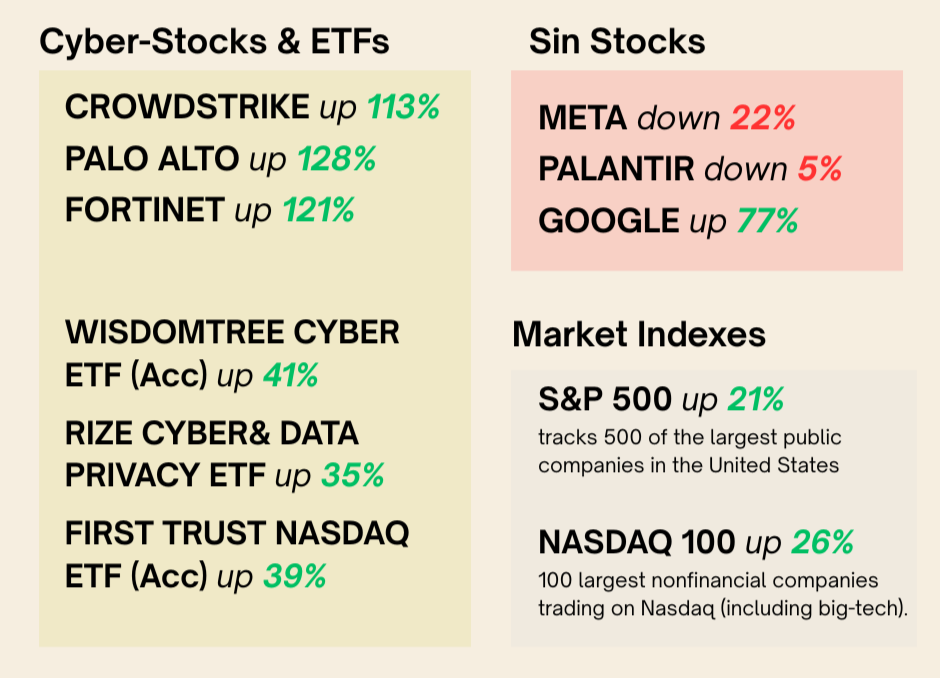
Data represents trailing 12-month illustrative performance up to Q3 2026. Past performance is not indicative of future results.
Ethics and outsized returns are pointing in the exact same direction. That is the entire thesis of this article, proven in a single chart.
5. How to invest in AI ethically through cybersecurity
Understanding the opportunity is only half the battle. The next step is execution.
If you want to add values-based investing tech stocks to your portfolio, you have two primary routes: individual stocks or Exchange Traded Funds (ETFs).
Picking individual stocks can yield massive rewards, as seen in the 120%+ gains above. However, it requires intense research and exposes you to high single-stock risk.
If one company misses an earnings report, your portfolio takes a massive hit.
For most retail investors, ETFs are the smarter play. As the data above proves, you don't have to be a master stock-picker to beat the market.
A diversified cybersecurity ETF spreads your risk across dozens of companies. You get broad exposure to the sector's growth without the stress of managing daily price swings.
But how do you ensure the ETF or stock you choose actually aligns with your values?
You have to look beyond the marketing and audit a company’s actual conduct, not just its product. This means checking for offensive military contracts, bad labor practices, and poor corporate governance.
Doing this manually is nearly impossible for a normal person. It takes dozens of hours of deep financial research.
This is exactly why the Ethika Index was built. It is a purpose-built tool that does this complex ethical screening for you in real time.
By using the Ethika Index, you ensure your money only flows into the companies fighting the good fight.
6. What ethical investors should still watch out for
We value transparency, so it is important to offer some honest caveats. No sector is perfect, and socially responsible tech stocks still carry risks.
Here is what you need to watch out for before deploying your capital:
The Surveillance Trap: As mentioned earlier, some legacy cyber firms have quiet divisions that sell offensive capabilities to questionable governments. You must screen these out.
Inconsistent ESG Ratings: Standard ESG (Environmental, Social, and Governance) scores are notoriously flawed. Different ratings agencies often give the exact same company wildly different scores.
Valuation Risks: Because cybersecurity is a high-growth sector, valuations can run extremely hot. If you buy at the absolute peak of a hype cycle, you can still lose money even if the company is growing.
These challenges are exactly why broad-market ESG funds consistently underperform. They rely on flawed, inconsistent data.
It also highlights why having a dedicated, specialized screener like the Ethika Index is non-negotiable. It cuts through the noise and answers the ultimate question: "How do I actually vet this?"
What this means for you
You do not have to choose between your conscience and your financial future. The myth that ethical investing requires accepting lower returns is officially dead.
As the AI revolution accelerates, the demand for digital protection will only compound. Cybersecurity is the rare sector that is high-growth, AI-powered, and ethically defensible.
It is the ultimate solution for the modern retail investor. Cybersecurity lets you back the explosive growth of AI, without accidentally owning the bad guys.
This article is for informational purposes only and does not constitute financial advice. Investing involves risk and the value of investments can go down as well as up. Past performance is not a guide to future returns. Always do your own research or consult a qualified financial adviser.
