
The big AI companies aren't building businesses. They're burning cash. Here is why the bubble is about to burst, and what comes next.
Last week a VC turned CTO told me that the big AI companies are actually profitable (Claude, Gemini, ChatGPT, Meta’s Llama).
We were talking about weather or not AI was a good investment. With OpenAI not planning to be profitable until 2030 - his comment surprised me.
I asked him a simple question - his answer revealed something shocking.
“What did you include when calculating the ‘cost’ of these AI models?”
He has a masters in data science from a top university. He has worked for a venture capital fund, and is now founding an AI company.
An expert in AI P&L right?Wrong.
He was measuring the cost of answering a question, and even then, only part of it. The GPUs, yes. The electricity to run them, no. Not the people. Not the buildings.
And, most importantly, not the cost of building the model that answers the question in the first place.
In this Article:
Why does profitability matter?
What does cost to make an AI model?
How do the unit economics work?
How do the costs pay off in the long run?
What will make the ‘AI Bubble’ burst?
Who will be the AI winners?
1 - Why does profitability matter?
The cost & profitability of a company has a direct impact on its viability, risk exposure, and its share price. The unit economics surrounding general purpose AI models is at the heart of the ‘AI bubble’ debate, and how big the fallout will be if it bursts.
Definition: General-purpose AI (GPAI)
The “Swiss Army Knife” of software. Unlike a calculator that only does math, these models (like ChatGPT or Claude) are built to do everything: they can write code, draft emails, diagnose medical symptoms, and write poetry - all at once.
A company that doesn’t make a profit survives only as long as someone keeps lending it money or buying its shares; when the losses grow faster than the confidence, the funding stops, the debt comes due, and the shares are worth whatever’s left after the creditors are paid, which is usually nothing.
2 - What does cost to make an AI model?
Before a GPAI model is released - it first has to be trained. At a high level, training an AI model has 3 core costs:
The Data: Buying, scraping, and licensing the internet.
The Cleanup: Scrubbing out the garbage so the model doesn’t output trash.
The Compute: The massive, recurring cost to actually “bake” the thing.
The Data
Every AI model is trained on data. The more different things a model is trying to do - the greater the amount of data the model requires to train it. For general purpose models - the cost of acquiring this data is HUGE.
The Cleanup
Once acquired, the data has to be cleaned, checked, stored somewhere fast enough to feed thousands of GPUs at once, and moved between them. Anyone who has worked on a training pipeline knows this is a real and unglamorous cost. But it’s a rounding error next to the next step.
The Compute
Training a frontier model on that data takes $100’s of millions to billions of dollars of compute, and the chips and memory that do it are now so scarce that memory prices nearly doubled in a single quarter this year.
3 - How do the unit economics work?
Having a high pre-launch cost is not necessarily a bad thing. It can often mean that a company has invested heavily in making a good product.
The theory: If the company spends a lot of money making a product, but that product will be around for a long time - you have a longer period of time to recoup these costs and make a profit.
In business, you spend big money upfront to make it back over years. It’s called amortization.
But AI doesn’t have years. It has months.
A GPAI models are superseded in 4-months and usually removed in 16.
You can’t pay back a multi-billion dollar investment when your product has the shelf life of a carton of milk.
So a model that costs billions to build has months, not years, to pay for itself. And because the next model has to be in training before the current one launches, development spend never becomes a one-off.
It is a permanent, rising cost of staying in the race.
GPT-5’s first 4-months: $6 billion in revenues and its gross profit from serving users at about $2 billion, against roughly $5 billion of research spent in the four months before it launched. The queries were profitable. The model was not.
4 - How do the costs pay off in the long run?
Those still touting general purpose AI as the best investment option will tell you that this is all a part of the process -
‘Sure - producing a model is expensive now - but those costs will get cheaper, and once adoption scales, revenue takes care of the rest.’
They are partly right. But not to the extent they think.
Yes - in the long run:
Code will get leaner,
Chips will get faster,
Power may get cheaper.
But that all relies on AI costs going down while adoption grows, with unencumbered access to resources.
5 - What will make the ‘AI Bubble’ burst?
The unit economics of GPAI depends on costs getting smaller and adoption (revenue) growing fast enough to recoup the losses before the debt gets out of hand.
All of this needs to happen in a very short space of time. Otherwise - the bubble bursts.
The Hidden Costs
Since you’re reading this article - you will know that there is a catch. Something in the equation isn’t adding up. And you’d be right.
The Data:
The current reported ‘cost’ of acquiring training data is just recording the amount of money AI companies have actually paid.
What the accounts don’t show: Companies didn’t pay for the training data; they scrapped it. They stole it. Many of the real owners of those books, photographs, and videos never saw a penny. But this is changing.
The largest Copyright payout in history: In July 2026, Anthropic’s $1.5 billion settlement with authors was approved: roughly $3,000 a book, for around 480,000 books downloaded from pirate libraries.
This sets the president the big AI companies have been dreading.
OpenAI and Suno have already been found liable - with damages still being calculated. Google, Udio, and OpenAI have ongoing cases - Google estimate their own exposure to be “$10Bs–$100Bs in potential fines.”
The message is clear - AI companies will have to pay fairly for the work they are using to train their models.
That means an enormous cost increase.
The Energy:
The grid is tapped out. A gas turbine takes 3 years to arrive; a nuclear plant takes a decade. In the world’s biggest data-centre hubs, the wait for a grid connection is now seven to ten years.
What this means: Increased short term demand means power prices are going up, not down.
Electricity supply grew about 3% last year, almost all of it seasonal (solar and wind). Data-centre demand grew 17%, and it needs power around the clock.
When demand outruns supply, prices go up. That means AI companies will need to pay data centres more to keep running. And that is before we start estimating the rising costs due to environmental harm.
The Adoption Paradox
Adoption here means the number of people using (and paying) for the product. Paying customers need to feel they are getting a good return on investment (ROI): the benefit they get from using the product, disproportionately outweighs the cost they pay.
Products that are expensive to make either need to have a high volume of paying customers (keep the overall product cost per user low); or they need to have a smaller volume of customers paying a very high amount. GPAI needs both.
When it comes to GPAI - value is measured in 2 key ways:
Performance: The quality of work the model produces.
Use Cases: The number of different things a customer can use the model for.
Performance:
Models don’t wear out. What wears out is the economics of serving them. When the number of users jumps, ‘supply’ becomes the problem. Providers quietly give each user less: shorter answers, cheaper routing, tighter limits, and sometimes bugs they take weeks to admit. Rapid growth of ‘free tier’ customers exacerbates this.
What this means: Users call this degradation. It is rationing.
In March 2026, the ‘Quit-GPT’ movement saw record numbers of customers switched from ChatGPT to Claude. Within days increasing numbers of Claude users reported a rapid decrease in performance and an increase in model hallucinations.
If model quality is inconsistent and changes without warning, but the cost keeps going up - paying users will look for alternatives where they feel they are getting better value.
Use cases:
AI companies are desperate for business revenue because that’s where the real money is. But there’s a wall: Regulation.
Businesses can’t use “black box” models for legal advice, medical decisions, or insurance payouts. It’s too risky.
What this means: If the AI company can’t meet regulatory standards, that places the liability squarely on the Company using it. Companies will still need to pay for lawyers, and accountants to have the final word on the big money problems.
The EU General Purpose AI Act requires that AI used for [xxx decisions] be consistent, auditable, transparent and explainable. Where most GPAI’s are ‘probabilistic’ rather than ‘deterministic’ - this is a standard they will not meet without human oversight. Going a step further - financial & legal regulators clearly state that AI cannot make regulated decisions without human oversight.
While AI can be used as a part of a process - it is being increasingly relegated to process optimisation and low value tasks. While this is still useful - the big money problems still require a human.
6 - Who will be the AI winners?
General-purpose AI is burning cash, but the AI industry isn’t dead. It’s just shifting.
It is possible to build models that require less data, less energy, and fewer raw materials - that are cheaper and just (if not more) effective.
When considering the future of AI - we need to look through 2 lenses:
Types of AI: Different types of model and their function.
AI Supply Chain: The raw materials and infrastructure it takes to run AI.
Here are the bets I’m making on where the future of AI is really going -
Types of AI
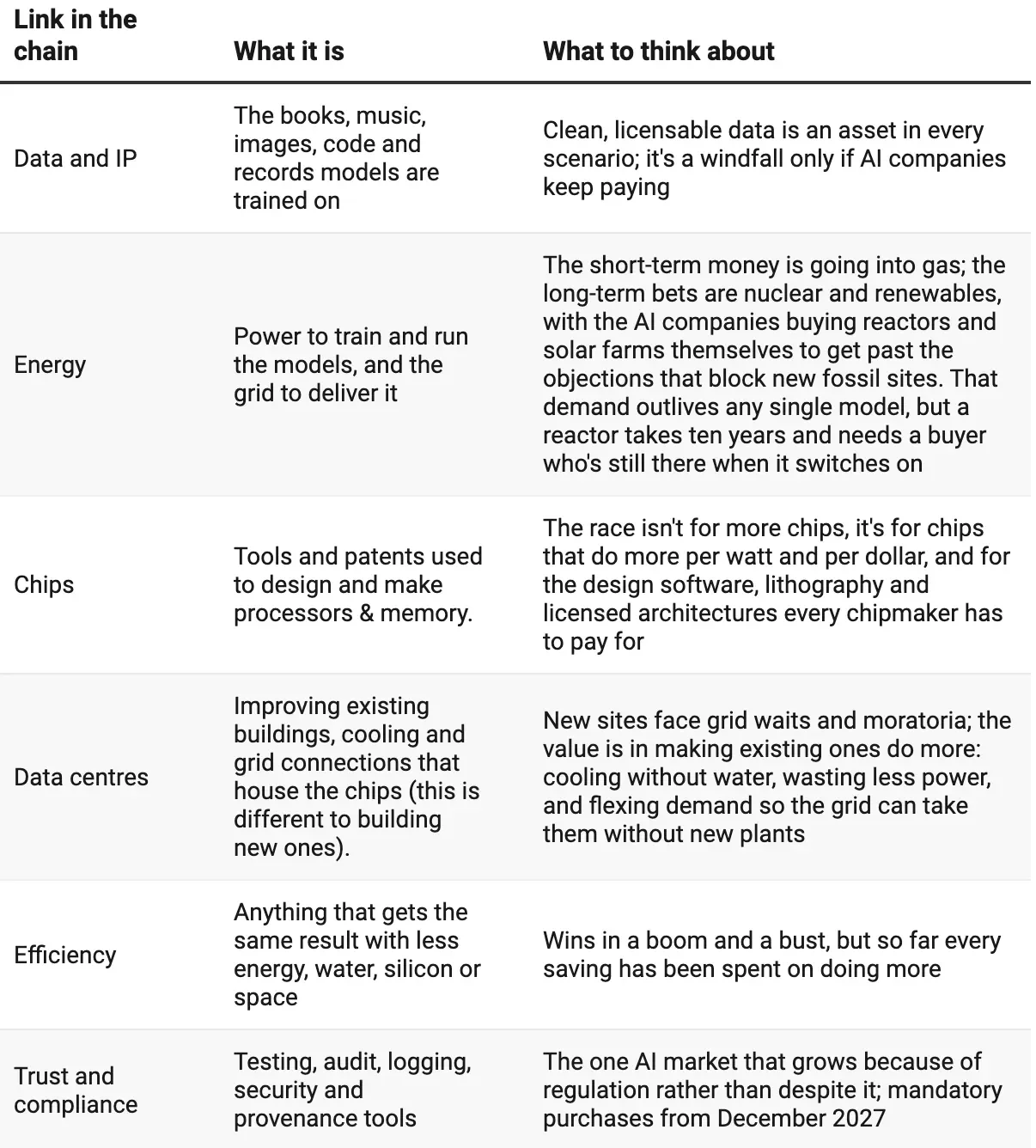
Despite taking up most of the conversation - general purpose models are only one piece in the puzzle.
The bubble might burst on GPAI - but that doesn’t mean it will crash for all AI.
Regulation is creating industries through mandatory requirements.
Testing, audit, logging, conformity assessment and model-monitoring tools become mandatory purchases for every business deploying high-risk AI from December 2027. Compliance is the one AI market that grows because of regulation rather than despite it.
AI Supply Chain
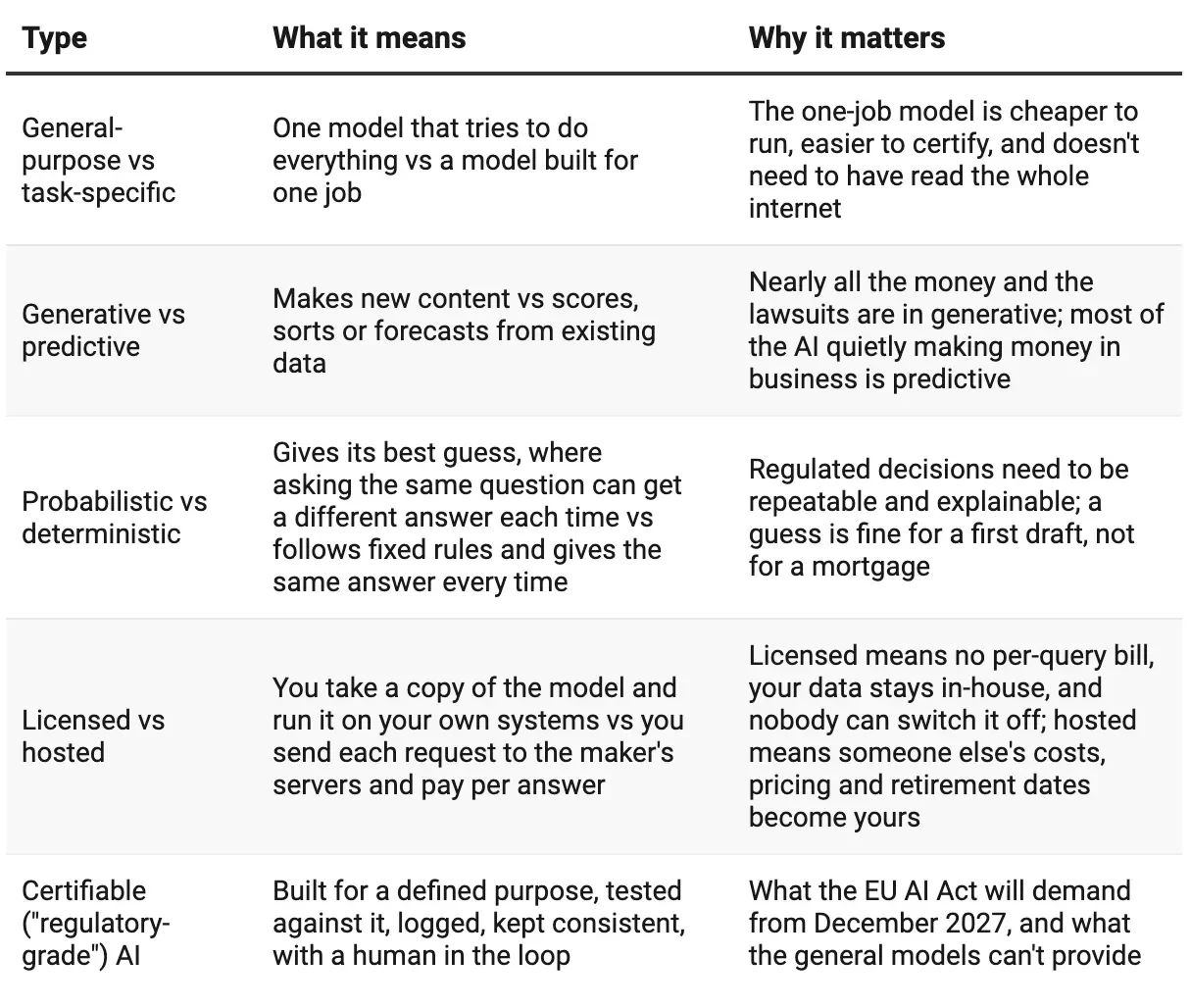
Energy, chips, and data centres have dominated the supply chain conversation. Their demand and current valuations are predicated
When content theft and environmental harm become liabilities necessitating change, not cost-savers; when responsible model development and protecting human’s rights & wellbeing become a competitive advantage - the future of AI starts to look a lot less dystopian.
This is the future I am excited for. As a user, and as an investor.
